- Builder and Developer Insights
- Posts
- AI Governance Policy
AI Governance Policy
In partnership with


Good morning!
June is here, and our focus remains clear: keep improving, keep serving customers well, and keep building momentum. Small, consistent wins compound and we’re just getting started.
— Lucas Robinson, Founder & CEO at BudgetMailboxes.com
🎯 This Week’s Strategy:
AI Governance Policy
🛠️ Boardroom Brief:
Purchase Lending Slump Signals a Tougher Conversion Environment for Builders
Strategy
🎯 AI Governance Policy
Artificial intelligence is quickly becoming part of the builder and developer toolkit, from project planning and design support to market analysis, estimating, customer communication, scheduling, risk review, and document management. While AI can improve speed, consistency, and decision-making, it also introduces new risks around data privacy, accuracy, intellectual property, bias, cybersecurity, and regulatory compliance.
An AI Governance Policy gives builders and developers a clear framework for how AI tools should be used across the organization. Rather than allowing teams to adopt AI informally and inconsistently, a governance policy establishes rules for approved tools, acceptable use, human review, data protection, and accountability. The goal is not to slow innovation. The goal is to make AI useful, safe, and aligned with business objectives.
For developers managing complex projects, large vendor networks, sensitive financial data, customer information, and compliance obligations, AI governance is becoming a critical operational strategy.
How to Implement an AI Governance Policy in Your Organization
✅ Identify Where AI Is Already Being Used
Start by understanding how your teams are currently using AI. This may include design assistance, proposal writing, contract review, customer service, financial modeling, scheduling, code compliance research, marketing content, or vendor communications. Builders and developers should map these use cases before setting rules so the policy reflects real workflows instead of theoretical concerns.
✅ Define Approved and Prohibited Uses
Create clear guidelines for what AI can and cannot be used for. For example, AI may be useful for drafting internal summaries, analyzing project data, or generating early-stage marketing concepts, but it should not be used to make final legal, financial, engineering, design, or compliance decisions without qualified human review. The policy should also prohibit uploading confidential contracts, customer data, employee records, proprietary plans, or sensitive financial information into unapproved tools.
✅ Require Human Review for High-Stakes Outputs
AI can produce inaccurate, incomplete, or outdated information. Any AI-generated output that affects budgets, contracts, permitting, safety, design decisions, customer commitments, or regulatory compliance should be reviewed by the appropriate professional before action is taken. A strong governance policy makes clear that AI can support decision-making, but it should not replace professional judgment.
✅ Set Data Privacy and Security Standards
Builders and developers often work with sensitive information, including site plans, investor documents, buyer data, subcontractor pricing, employee records, and proprietary project details. Establish rules for what information may be entered into AI platforms, which tools are approved, how outputs should be stored, and who is responsible for monitoring compliance. IT and legal teams should be involved in reviewing AI vendors and privacy terms.
✅ Create Accountability Across Departments
AI governance should not sit with one person alone. Assign responsibility across leadership, legal, IT, operations, marketing, finance, and project management. Each department should understand how the policy applies to its work. Consider creating a small AI review committee to evaluate new tools, approve use cases, and update the policy as technology and regulations evolve.
✅ Train Teams on Practical Use and Risk Awareness
A policy is only effective if employees understand it. Provide practical training on approved tools, safe prompting, fact-checking, data restrictions, and appropriate human review. Training should focus on real examples from the construction and development environment so team members know how to use AI productively without creating unnecessary risk.
✅ Review and Update the Policy Regularly
AI tools, laws, and industry standards are changing quickly. Treat the AI Governance Policy as a living document. Review it at least annually, or more often if your organization adopts new tools, expands into new markets, or faces new compliance requirements.
Why It Matters
AI has the potential to help builders and developers work faster, improve planning, reduce administrative burden, and make better use of project data. But without governance, the same tools can create legal exposure, security gaps, inaccurate decisions, and reputational damage. A well-designed AI Governance Policy allows organizations to capture the benefits of AI while maintaining control, transparency, and professional oversight.
For builders and developers, the competitive advantage will not come from using AI casually. It will come from using AI responsibly, consistently, and strategically.
Investors see ANOTHER return from Masterworks (!!!!)

That’s 6 sales in 7 months. 29 all time. And the performance?
16.5%, 17.6%, and 17.8%, net annualized returns on sold works held longer than one year (See all 29 at Masterworks.com)
It’s not from stocks, private equity, or real estate… it’s from contemporary and post war art. Crazy, right?
With Masterworks, you don’t need to be a BILLIONAIRE to invest in multi-million dollar art anymore.
Historically, the segment overall has had attractive appreciation and low correlation to stocks.*
Masterworks targets works featuring legends like Banksy, Basquiat, and Picasso, identifying what they believe to have significant long-term appreciation potential, not just at the artist level but at the level of individual artworks.
As one of the largest players in the art market, with $1.3 billion invested over 500 artworks, they pass critical advantages through to their 70,000+ members to add art to their portfolios strategically.
Looking to diversify your investments in 2026?
*According to Masterworks data. Investing involves risk. Past performance is not indicative of future returns. See important Reg A disclosures at masterworks.com/cd.
Boardroom Brief
Purchase Lending Slump Signals a Tougher Conversion Environment for Builders

New ATTOM data shows that U.S. home purchase lending fell to its lowest level in 12 years during the first quarter of 2026, with roughly 581,000 purchase loans originated from January through March, down 19% from the prior quarter. Elevated home prices, mortgage rates above 6%, limited inventory, and broader economic uncertainty continue to keep many prospective buyers on the sidelines. For builders and developers, the takeaway is clear: demand may still exist, but affordability pressure is making buyer conversion more difficult. Projects that depend on traditional for-sale absorption should be evaluated carefully against current financing conditions, cancellation risk, and local buyer sensitivity. In this environment, builders may need to sharpen affordability strategies through smaller floor plans, phased releases, targeted incentives, rate buydown partnerships, and product mixes that better align with today’s constrained borrowing power.
 | Curious About AI? |
Game
🎉 Fun Finale: Play & Poll
What is the most effective way builders can respond to today’s affordability-constrained market?(Tap on your answer) |
 Real workflows. Real results | Curious About Agentic AI?A FREE community where agentic AI workflows are built and shared. |
Your ads ran overnight. Nobody was watching. Except Viktor.
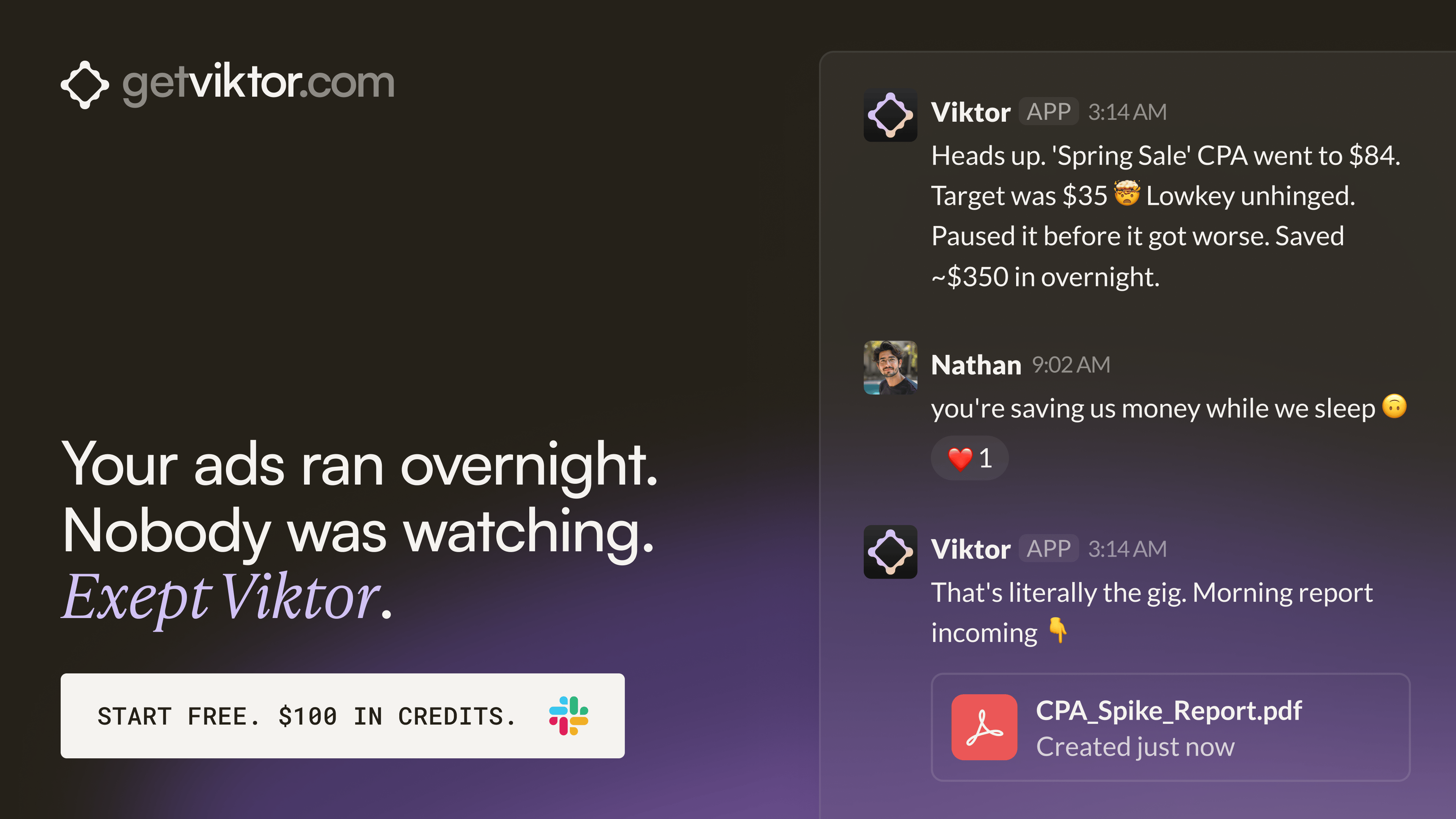
One brand built 30+ landing pages through Viktor without a single developer.
Each page mapped to a specific ad group. All deployed within hours. Viktor wrote the code and shipped every one from a Slack message.
That same team has Viktor monitoring ad accounts across the portfolio and posting performance briefs before the day starts. One colleague. Always on. Across every account.